In 1949, Carl Jung sat down to write what he knew would be a controversial introduction.
The book was a new English translation of the I Ching—a 3,000-year-old Chinese divination text. Jung, then in his mid-seventies and one of the most respected psychologists in the world, was staking his professional reputation on a book about fortune-telling.
His foreword would introduce a concept that has shaped how millions of people think about meaning, coincidence, and the nature of reality itself.
The concept was synchronicity—and understanding it changes how you approach the I Ching, decision-making, and the strange way that life sometimes seems to answer questions we haven't spoken aloud.
Jung's Problem with Causality
To understand why Jung was drawn to the I Ching, you need to understand what he was struggling with.
By the mid-20th century, Jung had spent decades studying the unconscious mind. He'd documented patterns that appeared across cultures—archetypes, universal symbols, collective structures of human psychology. He'd worked with thousands of patients and seen things that the conventional scientific model couldn't explain.
Not supernatural things. But meaningful coincidences.
A patient dreams of a scarab beetle, and as she describes the dream, a scarab-like beetle flies into the window of Jung's office. A man contemplates suicide, and the phone rings with news that changes everything. Someone asks a question, and the next person they meet happens to provide exactly the information they needed.
Jung noticed these events weren't random. They seemed to cluster around moments of psychological significance—when someone was on the edge of transformation, when important choices were being made, when the unconscious was trying to speak.
But there was no causal explanation. The beetle didn't fly in because the patient was describing a beetle dream. The events were connected by meaning, not by cause and effect.
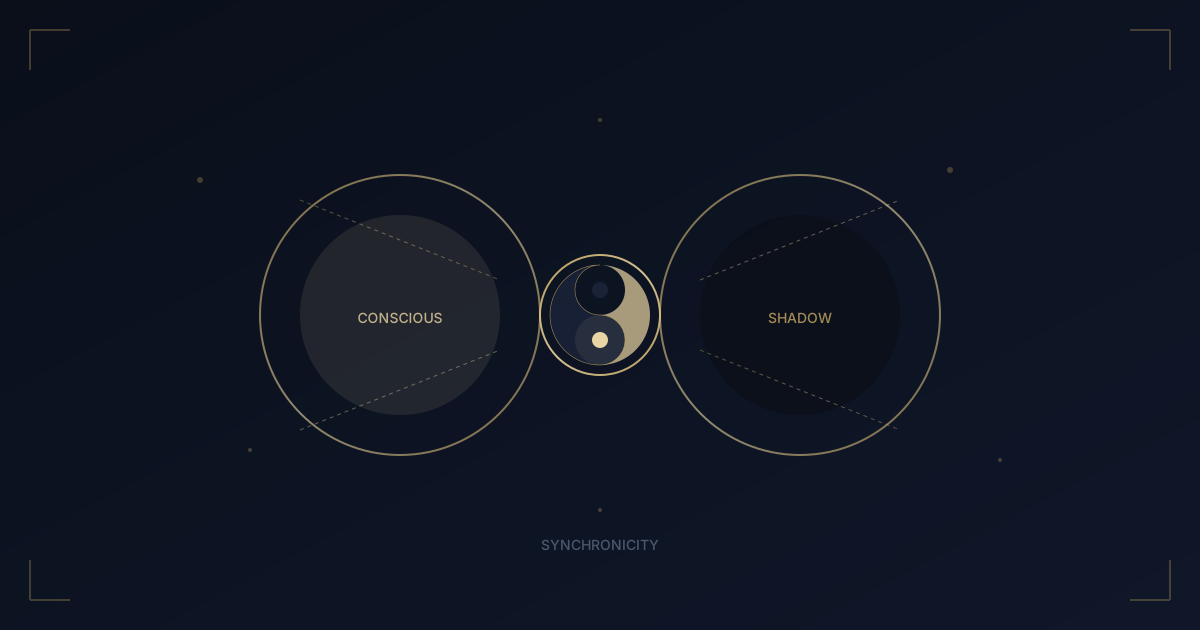
Jung needed a word for this. He called it synchronicity: "the simultaneous occurrence of events which appear significantly related but have no discernible causal connection."
What Jung Found in the I Ching
The I Ching gave Jung a laboratory for studying synchronicity.
Unlike Western methods of decision-making, which are based on analyzing causes and predicting effects, the I Ching operates on a completely different principle. It uses chance—the random fall of coins or yarrow stalks—to generate an answer. There's no causal link between your question and the hexagram you receive.
And yet, Jung found, the answers were meaningful. Uncannily so.
"For more than thirty years I have interested myself in this oracle technique, or method of exploring the unconscious, for it has seemed to me of uncommon significance... I found that the I Ching was invariably giving answers that were of such relevance to my questions that I was astonished time and again."
Jung wasn't claiming the I Ching was magic. He was claiming that meaningful connections exist outside of causality—and that the I Ching was a technology for accessing them.
Synchronicity vs. Fortune-Telling
Here's the crucial distinction that separates Jung's understanding of the I Ching from mere superstition:
Fortune-telling assumes a fixed future that can be predicted. You consult the oracle to find out what will happen.
Synchronicity assumes that meaning connects present and future in ways that aren't causal. You consult the oracle to understand what's actually happening right now—the hidden dynamics, the psychological forces, the archetypal pattern—so you can make a wiser choice.
The I Ching, in Jung's interpretation, isn't predicting your future. It's revealing your present. And because your present shapes your future, that revelation changes what happens next.
This is why the I Ching's guidance is actionable. It tells you whether to push forward, hold position, or retreat—not because the future is fixed in one of those directions, but because the present moment has a character, and certain actions align with that character better than others.
The Shadow: Jung's Other Great Concept
But synchronicity isn't the only Jungian concept that connects to the I Ching. There's another one that's arguably even more important for practical use:
The Shadow.
In Jung's psychology, the shadow is the part of ourselves we don't want to acknowledge. It contains everything we've repressed, denied, or refused to see—not just our darkness, but also our potential, our power, and our uncomfortable truths.
The shadow isn't bad. It's just hidden. And when it stays hidden, it sabotages us. We act out patterns we don't understand. We make the same mistakes repeatedly. We undermine our own success through blind spots we can't see.
Jung believed that psychological growth required "shadow work"—the gradual process of acknowledging, integrating, and owning the parts of ourselves we've exiled.
And here's where the I Ching becomes a tool for shadow work.
Shadow Warnings: The I Ching's Psychological Depth
Traditional I Ching texts include warnings and cautions alongside their guidance. But modern interpretations have made this element explicit and psychologically sophisticated.
When you receive guidance from the I Ching, you don't just get an instruction. You get a shadow warning—a specific prediction about how you're likely to sabotage the advice.
If your guidance is "Lead with precision":
Shadow warning: "Overreach. Power without restraint becomes sabotage."
This isn't generic caution. It's saying: "You're going to receive this advice and your ego is going to hear 'dominate everything.' Watch out."
If your guidance is "Wait for conditions to form":
Shadow warning: "Anxiety loop. Motion is not progress."
You'll mistake busywork for productive patience. You'll feel like you're doing something, but you're just spinning.
If your guidance is "Retreat strategically":
Shadow warning: "Pride. Staying to prove a point is how you lose."
You know you should pull back, but your ego won't let you. You'll stay in a losing position because leaving feels like admitting defeat.
This is shadow work in real-time. The I Ching names the unconscious pattern that will sabotage you—so you can see it before it happens.
Why "Shadow OS" Makes Sense
This is why Shadow OS: I Ching Oracle is named what it is.
It's not just an I Ching app. It's an operating system for working with your shadow—the hidden patterns that shape your decisions without your awareness.
Every reading includes:
- Guidance for your specific dimension (Career, Love, Conflict, Energy, Timing)
- A shadow warning that names exactly how you'll likely undermine yourself
- An action type (Push, Stabilize, Retreat) so you know the energy required
- Tracking so you can see patterns over time
That last part matters. Jung emphasized that shadow work isn't a one-time insight—it's an ongoing practice of noticing your patterns. By tracking whether you followed the guidance, adjusted, or failed, you build a map of your own psychological tendencies.
Which shadow warnings do you ignore most often? Which patterns keep appearing in your readings? When do you "push" when you should "stabilize"?
This is empirical shadow work. Not navel-gazing, but data.
Work With Your Shadow
Shadow OS gives you I Ching guidance with Jungian shadow warnings built in—plus tracking to see your patterns over time.
Download on AndroidJung's Method: How to Consult Properly
Jung was specific about how to approach the I Ching. It wasn't casual:
1. Bring a real question. Jung never consulted frivolously. The I Ching responds to genuine inquiry—questions that matter, questions where you're genuinely uncertain.
2. Be specific. Vague questions get vague answers. "What should I do about my life?" is too broad. "How should I approach this conversation with my boss tomorrow?" is specific enough to receive actionable guidance.
3. Accept that you might not like the answer. Jung noted that the I Ching often told him things he didn't want to hear. That's part of its value. If you're only willing to hear confirmation, you're not doing shadow work.
4. Sit with the response before acting. The I Ching speaks in archetypal language. The meaning often becomes clear after reflection, not immediately.
5. Treat changing lines as the core message. In traditional I Ching practice, "changing lines" indicate the dynamic elements of your situation—the parts that are actively transforming. Jung paid special attention to these.
Synchronicity in Practice
What does synchronicity actually feel like?
It's not usually dramatic. It's more like this:
You've been struggling with a decision for weeks. You consult the I Ching. The hexagram you receive describes your situation with eerie accuracy—naming dynamics you hadn't consciously articulated, warning about a blind spot you'd been avoiding.
There's no causal explanation. The coins fell randomly. But the meaning lands.
Or:
You receive guidance to "retreat strategically" in a conflict situation. You don't want to—your ego wants to fight. The shadow warning says "Pride. Staying to prove a point is how you lose."
You ignore it. You stay and fight. You lose—exactly the way the warning predicted.
Looking back, you realize: the I Ching wasn't predicting the future. It was showing you what you were already doing. The pattern was visible; you just couldn't see it.
The Integration: Using This Daily
Jung didn't treat the I Ching as a party trick or occasional curiosity. He used it as a genuine decision-making tool throughout his life.
Here's how to integrate it into your own practice:
Morning intention: Before a day with important decisions, consult on the dimension that matters most. Not every day—just when you're facing genuine uncertainty.
Pattern tracking: After each reading, note whether you followed the guidance. Over weeks, you'll see your shadow tendencies mapped out in data.
Shadow integration: When you notice the same warnings appearing repeatedly, that's your shadow speaking. What are you consistently refusing to see?
Decision review: When a decision resolves—well or poorly—go back and check what the I Ching said. Not to prove it "right" or "wrong," but to understand the pattern.
The Deeper Point
Jung's engagement with the I Ching wasn't about proving synchronicity to skeptics. It was about developing a practice for accessing wisdom that analytical thinking can't reach.
The Western mind trusts causality: A causes B, we predict B, we act on A. This is powerful for engineering, science, and logic.
But decisions aren't engineering problems. They involve uncertainty, emotion, unconscious dynamics, other people's hidden motivations, and timing that can't be calculated.
The I Ching accesses a different kind of knowing—what Jung called "the wisdom of the unconscious." It reveals patterns you can't see because you're inside them. It names shadow dynamics your ego won't admit.
And it provides this through a process that your rational mind can't game. You can't make the coins fall a certain way. You receive what you receive.
For overthinkers, this is liberation. For skeptics, it's at least worth one experiment.
Try the Experiment
Jung's approach to the I Ching was empirical: try it and see.
If you're curious, here's the experiment:
Think of a genuine decision you're facing—something with real uncertainty, where you've been stuck.
Consult the I Ching with a specific question.
Note the guidance and the shadow warning.
Then watch. Does the pattern described match your situation? Does the shadow warning name something you've been avoiding?
You don't have to believe anything in advance. Just notice.
Jung spent thirty years with the I Ching. You can start with one question tonight.
See What the I Ching Reveals
Shadow OS gives you the Jungian framework—including shadow warnings—in a modern, trackable format. Free to start.
Download on Android